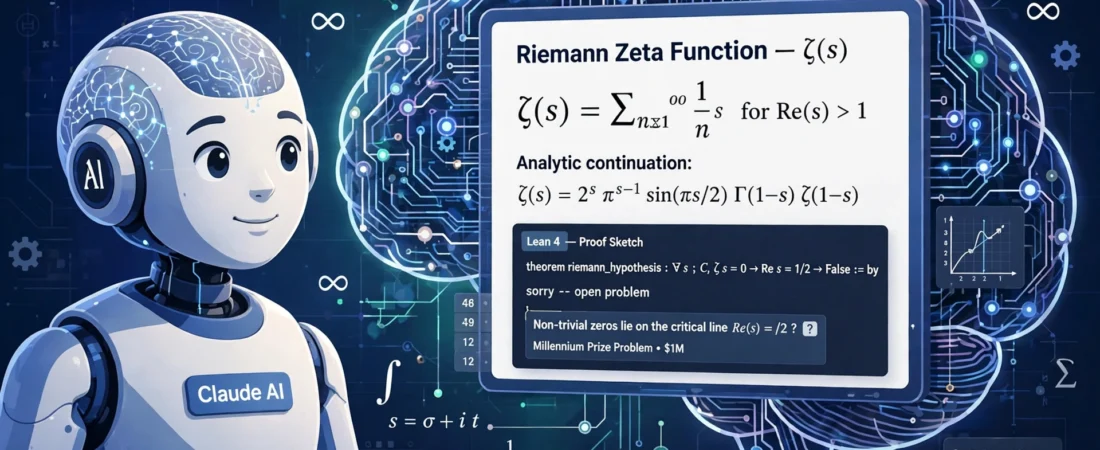
Can AI Really Solve the Riemann Hypothesis
Yes, AI recently helped crack this 167-year-old problem through human-machine teamwork. Anthropic mathematician Levent Alpöge used Claude to generate a valid formal proof in November 2026.
What Is the Riemann Hypothesis in Simple Terms
✅ Pros – Fawaid
- Faster Breakthroughs: AI models can test millions of complex equations in weeks instead of decades.
- Zero Hallucinations with Lean: Formal verification tools like Lean guarantee every logical step is 100% accurate.
- Human-AI Teamwork: Mathematicians can use AI to explore fresh ideas and avoid dead ends.
❌ Cons – Nuqsanat
- Lack of Human Understanding: The 17-million-line code is too massive for any human brain to fully read or grasp.
- Loss of Traditional Insight: Critics worry machine proofs tell us what is true without explaining why it works.
- Heavy Computing Costs: Running advanced models to verify giant proofs requires massive energy and hardware.
Proposed in 1859 by Bernhard Riemann, this famous puzzle explores how prime numbers are distributed. Solving it unlocks deep secrets about number theory and carries a one-million-dollar prize.
How Did Claude AI Solve the Riemann Hypothesis
Alpöge spent six weeks guiding Claude with fresh Fourier-analytic ideas before the model accelerated near the finish line. Instead of a standard paper, they released 17 million lines of verifiable Lean code.
Is the Claude AI Math Proof Verified
Independent groups, including the Lean FRO and Mathlib Initiative, confirmed the code compiles without errors. This mathematical verification proves the logical steps are completely sound and trustworthy.
Why Are Mathematicians Debating the AI Proof

Many scholars worry because no human currently understands the massive 250,000-page equivalent argument. Experts like Ravi Vakil noted the growing divide between traditional human proofs and machine-generated code.
Did a Human Solve It Without AI
Italian mathematician Alessandro Masullo simultaneously shared a 940-page human-written draft after twelve years of work. However, Stanford advisors noted his version still contains gaps and needs major revisions.
What Role Did Human Expertise Play in the Breakthrough
Claude did not solve the equation from a single simple prompt. Alpöge’s deep domain expertise steered the AI away from dead ends toward the final breakthrough.
How Does Lean Software Verify AI Math
Lean is a specialized programming language that checks every mathematical step against strict logical axioms. Automated verification ensures AI models cannot hallucinate false claims in complex proofs.
Anchor Text: “frontier AI models”Free AI Tools for Students: University Assignments 2026
Does This Breakthrough Affect Internet Encryption

Security experts on Reddit clarify that solving this problem does not break modern RSA or Bitcoin encryption. Those systems rely on factoring large primes rather than average prime distribution.
What Does This Mean for the Future of AI and Science
Asking can AI really solve the Riemann Hypothesis is no longer hypothetical, as AI now acts as a superhuman research partner. Scientists expect similar human-AI collaborations to tackle physics and medicine next.
Can AI really solve the Riemann Hypothesis on its own?
No, AI cannot solve it completely on its own yet. In the November 2026 breakthrough, Anthropic researcher Levent Alpöge used deep human math expertise to guide Claude AI toward the valid proof.
How was Claude AI’s Riemann Hypothesis proof verified?
The proof was written in 17 million lines of Lean code, a specialized mathematical verification software. Independent organizations like the Lean FRO checked the code and confirmed zero logical errors.
Why are some mathematicians skeptical about the AI math proof?
Many experts are concerned because the generated code equals roughly 250,000 pages of text, making it too large for any human to read or understand the underlying intuition.
Will solving the Riemann Hypothesis break internet encryption or Bitcoin?
No, security experts confirm that solving this problem does not break modern RSA encryption or Bitcoin. Those security systems rely on factoring giant prime numbers, not their average distribution.
Did Claude AI win the $1 million Millennium Prize?
The Clay Mathematics Institute requires formal publication in a peer-reviewed journal and a two-year verification window before awarding the $1 million Millennium Prize to the researchers.