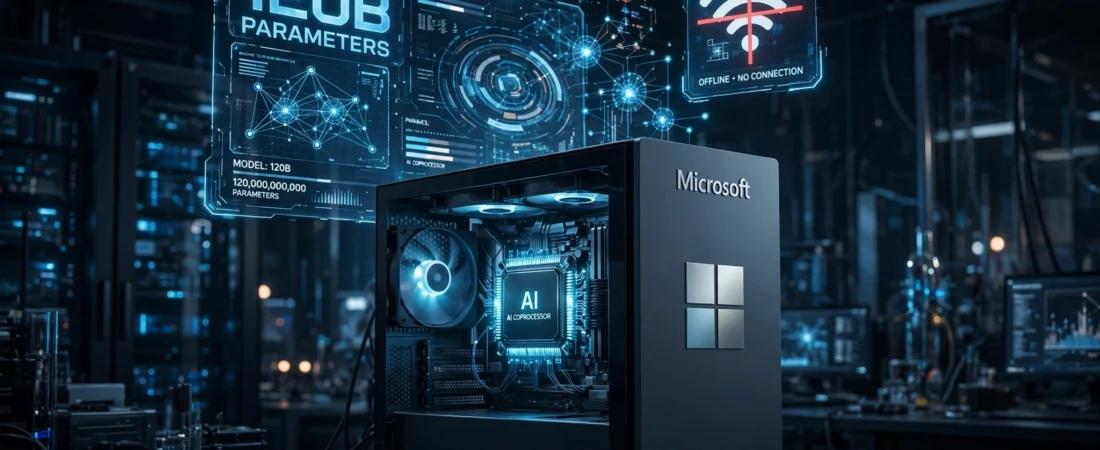
Imagine a workstation that reasons, translates, and generates text at the scale of the largest cloud models—yet never sends a byte beyond your desk. The new Microsoft Offline AI PC makes that vision real, delivering on‑device AI that runs entirely without an internet connection.
Targeted at developers, enterprises, and privacy‑conscious users, the desktop packs a high‑performance neural processing unit and 128 GB of DDR5 memory, enabling local loading and execution of language models up to 120 billion parameters. It can fine‑tune, infer, and experiment with massive AI workloads while keeping every piece of data locked inside the chassis.
With data breaches and latency concerns limiting AI adoption, the Offline AI PC sidesteps bandwidth bottlenecks, reduces exposure to remote attacks, and complies with strict governance policies.
The next sections detail how the device achieves these capabilities, compare its privacy posture to online services, and examine what true on‑device AI means for developers and enterprises.
What is Microsoft Offline AI PC?

The Microsoft Offline AI PC is a purpose‑built desktop engineered to bring large‑scale artificial intelligence to the edge. At its core sits a high‑performance neural processing unit (NPU) that accelerates the matrix multiplications underpinning transformer architectures. Complementing the NPU is 128 GB of DDR5 RAM, giving the system enough memory to load the full weight set of models with up to 120 billion parameters without resorting to cloud‑based sharding.
Out of the box the machine ships with a curated suite of AI tools—frameworks, model libraries, and inference engines—that are pre‑installed and optimized for the integrated hardware. This software stack enables developers to spin up, benchmark, and run massive language models locally, making the Microsoft Offline AI PC one of the most capable offline AI platforms currently available.
Beyond inference, the device supports on‑device fine‑tuning. Developers can retrain or adapt the bundled models using proprietary data while the entire training pipeline remains confined to the workstation. Because no data ever leaves the chassis, confidentiality is preserved end‑to‑end, eliminating the compliance and security concerns associated with sending sensitive information to remote servers.
How Microsoft Offline AI PC Runs 120B Models Without Internet?

The Microsoft Offline AI PC relies on a purpose‑built neural processing unit (NPU) that is tuned for the dense linear algebra at the heart of transformer architectures. By offloading matrix multiplications to dedicated silicon, the NPU reduces latency and cuts the power budget compared to running the same workloads on a general‑purpose GPU.According to the Microsoft AI PC announcement, this new system uses a dedicated AI coprocessor.
Together with 128 GB of DDR5 memory, the workstation can hold the entire weight tensor of a 120 billion‑parameter model in a single address space. This eliminates the need for model sharding, a common requirement when deploying such large models over cloud infrastructure. Because the full model resides locally, inference calls can be satisfied with a single memory lookup, dramatically improving response times and removing any reliance on external bandwidth.
The integrated NPU also supports high‑throughput batch processing. When a stream of requests arrives, the accelerator pipelines the matrix operations, delivering consistent performance across dozens of concurrent queries. This capability makes the Microsoft Offline AI PC a practical choice for edge scenarios such as autonomous robotics, real‑time translation kiosks, or on‑premise analytics platforms, where low latency and guaranteed availability are paramount.
Microsoft Offline AI PC vs Online AI (Privacy Comparison Table)

Microsoft Offline AI PC vs Online AI (Privacy Comparison)
| Aspect | Microsoft Offline AI PC | Online AI Services |
|---|---|---|
| Data residency | All data stays on the device; no network transmission. | Data is uploaded to remote servers for processing. |
| Encryption | End‑to‑end encryption applied by default to storage and inter‑process communication. | Encryption is used in transit, but data is decrypted on the provider’s infrastructure. |
| Breach exposure | Zero exposure to external networks; breach risk limited to physical device security. | Centralized clouds are attractive targets; a single breach can affect many customers. |
| Compliance | Enables on‑premise governance, supporting regulations that require data to remain in‑house (e.g., GDPR, HIPAA, local data‑sovereignty laws). | Compliance depends on the provider’s certifications; customers must trust third‑party audit results. |
| Bandwidth dependency | No internet required; performance is consistent regardless of network quality. | Requires reliable, high‑speed connectivity; latency and throttling can degrade response times. |
| Scalability of governance | Enterprises can enforce custom policies, role‑based access, and audit trails locally. | Governance is limited to the SaaS platform’s built‑in controls; custom policies are rarely available. |
| Cost of data transfer | Eliminates egress fees and bandwidth costs. | Ongoing data‑transfer charges can become significant at scale. |
The table highlights that the Microsoft Offline AI PC offers a privacy‑first architecture, keeping data within the organization’s control, while online AI services trade convenience for exposure to network‑related risks and limited governance options.
Final Verdict
The Microsoft Offline AI PC proves that on‑device intelligence can match the scale of cloud‑based services while eliminating the privacy trade‑offs that have long plagued enterprise AI deployments. By housing a dedicated neural processing unit and 128 GB of DDR5 memory, it can load and run models up to 120 billion parameters without ever touching the internet. This architecture gives organizations full control over data, removes egress fees, and guarantees consistent latency regardless of network conditions.If you want a budget option, check our guide on best AI PC under 100000 PKR in Pakistan for 2026.
For developers, the ability to fine‑tune models locally means proprietary datasets stay in‑house, simplifying compliance with GDPR, CCPA, and sector‑specific regulations. Enterprises can enforce on‑premise governance policies, integrate the system into existing security frameworks, and avoid vendor lock‑in associated with SaaS AI platforms.
Performance‑wise, the NPU‑accelerated matrix operations deliver batch inference speeds that rival many cloud offerings, making the Microsoft Offline AI PC suitable for edge scenarios such as autonomous manufacturing lines, real‑time analytics, and secure customer‑facing applications.
In short, the Microsoft Offline AI PC delivers enterprise‑grade AI capabilities without compromising privacy, positioning it as a game‑changer for on‑device computing and a compelling alternative for any organization that values data sovereignty and predictable performance.
FAQ
FAQ
Q: Can I run other open‑source models on the Microsoft Offline AI PC besides the bundled 120 B model?
A: Yes. The Microsoft Offline AI PC is designed as a flexible AI workstation rather than a single‑purpose appliance. Its high‑capacity 128 GB DDR5 memory and dedicated neural processing unit (NPU) can accommodate a wide range of open‑source models, from compact BERT variants to larger transformer families such as LLaMA, Falcon, and GPT‑NeoX.
The key considerations are model size and memory footprint. Models that fit entirely within the available RAM can be loaded and executed without sharding, preserving the offline advantage. For models that exceed the 128 GB limit, you can employ quantization or model pruning techniques to reduce weight size, or use Microsoft’s on‑device model‑optimisation toolkit that automatically adapts checkpoints for the NPU.
Installation is straightforward: the pre‑installed AI suite includes a package manager that pulls models from popular repositories (Hugging Face, GitHub) and configures them for hardware acceleration. Because the entire pipeline runs locally, you retain full data sovereignty and can fine‑tune models with proprietary datasets without ever exposing information to the cloud.
Takeaway: The Microsoft Offline AI PC supports a broad ecosystem of open‑source models, giving developers the freedom to choose the right architecture for their workload while keeping all computation and data securely on‑device.
;